How Vertical SaaS and AI Are Reshaping Enterprise Software
The enterprise ERP software market is a colossal one, estimated by Morgan Stanley to be a $220 billion annual industry, largely dominated by giants like SAP. Yet, a significant portion of this market still relies on legacy on-premise systems. These traditional setups, built around vast data depositories, struggle to leverage insights, context, and workflow optimization from the disparate, independent, and external datasets that define today's digital landscape.
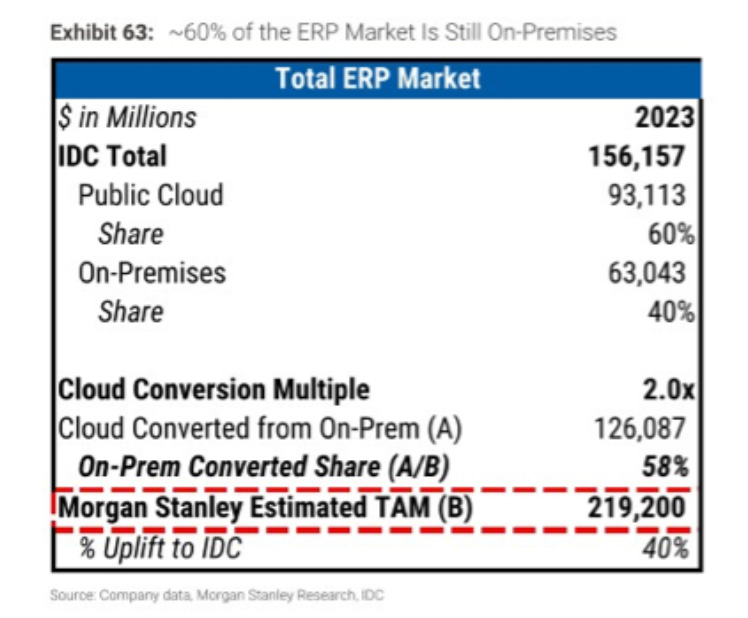
This image from Morgan Stanley Research as part of their report clearly illustrates that a substantial 40% of the ERP market was still on-premises in 2023, with a significant estimated total addressable market.
However, the tide is turning. Lightspeed's May 2025 post on ERP unbundling presents a compelling thesis: the ERP market is on the cusp of its most profound disruption in two decades. This disruption centers on the modularization of systems, where best-in-class software solutions for specific functions can seamlessly interoperate within a cloud
environment. I firmly believe this fragmentation is not just inevitable but necessary, driven by increasingly sophisticated customer expectations and the ubiquitous nature of cloud infrastructure. This modular landscape promises to usher in faster innovation, quicker alignment to evolving business priorities, and a fertile ground for new providers to capture significant market share.
The recent BOND report powerfully underscores the relevance of Artificial Intelligence as the next frontier. They emphasize the unprecedented speed of development and innovation within the AI space. In such a rapidly evolving environment, large horizontal SaaS providers simply cannot iterate with the agility and effectiveness required. To imagine a new framework for technology offerings without considering AI's profound impact and demands is, at this point, illogical.
With AI firmly in the picture, the contextual nature of a new, decentralized ERP paradigm becomes even more critical. This is where I see Vertical SaaS (vSaaS)providers emerging as the clear market leaders. They are uniquely positioned to deliver focused and immensely valuable modules that either enable or deeply rely on Generative and Agentic AI.
David Haber at a16z recently articulated his "wedge theory," where vertical SaaS companies leverage AI to replace human-intensive workflows upstream from the system of record, gradually expanding deeper downstream into the broader enterprise environment. For ERP modules covering areas like supply chain, order flow, compliance, and similar functions—which are often heavy on workflow decisions based on unstructured data—this "wedge-model" of market acquisition is an ideal fit.
I am convinced that vSaaS solutions will not only transform but eventually lead the ERP segment. Their value proposition lies in their ability to more intimately address the nuanced needs of various industries, all while effectively leveraging AI tools trained on models that are precisely tuned and deliver highly valuable insights. The future of ERP is modular, cloud-native, and profoundly intelligent, with vSaaS at its core.